Search This Blog

Tuesday, July 6, 2021

Creating a Sample file in Intuit QuickBooks Desktop

Sample company file already contains customers, invoices and other transactions so whatever you test will have no impact on your own company’s data. To get started:

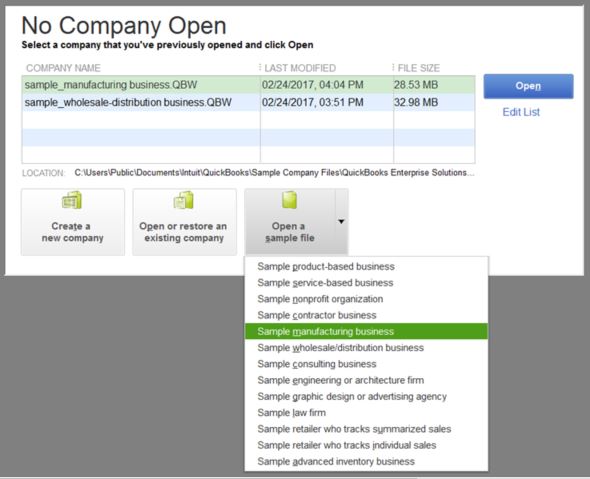
    Click the Open a sample file drop-down menu and click to select the sample business that most closely matches your own. Note that the number and type of sample data files installed will depend on the version of QuickBooks you purchased.blog-img-quickbooks-open-sample-company
  1. Launch QuickBooks.
  2. If your own company file opens up automatically, go to the File menu, choose Close Company and the 'No Company Open' window will appear.
  3. To get back to your own company file, simply close the sample file (following the directions from above) and select Open or restore an existing company.

Friday, June 21, 2019

Using Hiren's Boot CD to Create Admin User Accounts

Overview

If you’ve ever forgotten a password and none of the usual tricks work to get you back into your Windows box, then a boot CD like Hiren is a must. Of all the things that you can do with this boot disc none is as useful as making admin accounts. What this means is that if you have physical access to a machine then there is nothing to prevent you from gaining administrative access.
You can download the ISO for Hiren at https://www.hirensbootcd.org/download. This article presumes you already know how to create a boot disc from and ISO image and can boot to it. If you’ve never used the Hiren Boot CD before then do yourself a favour and try it. It is an indispensable tool in any technician’s bag of tricks.

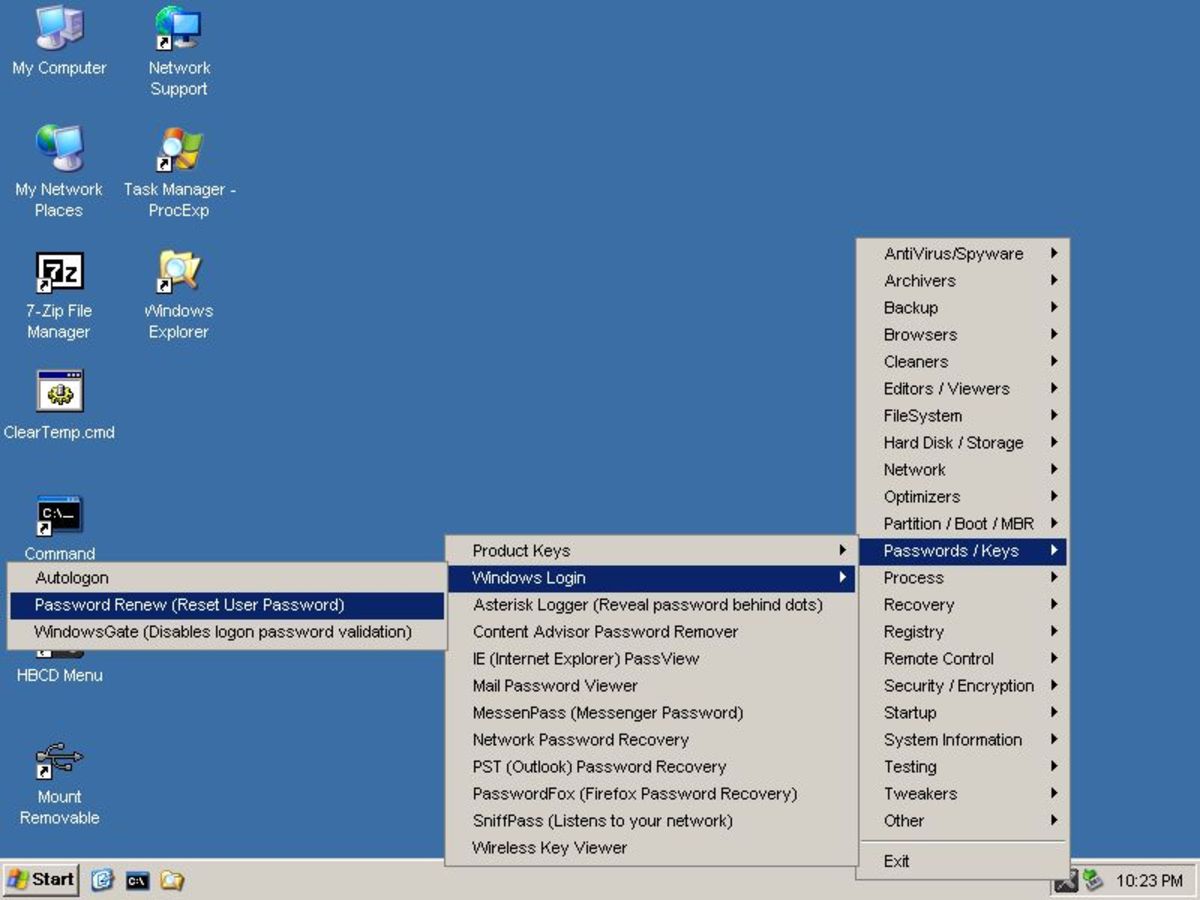
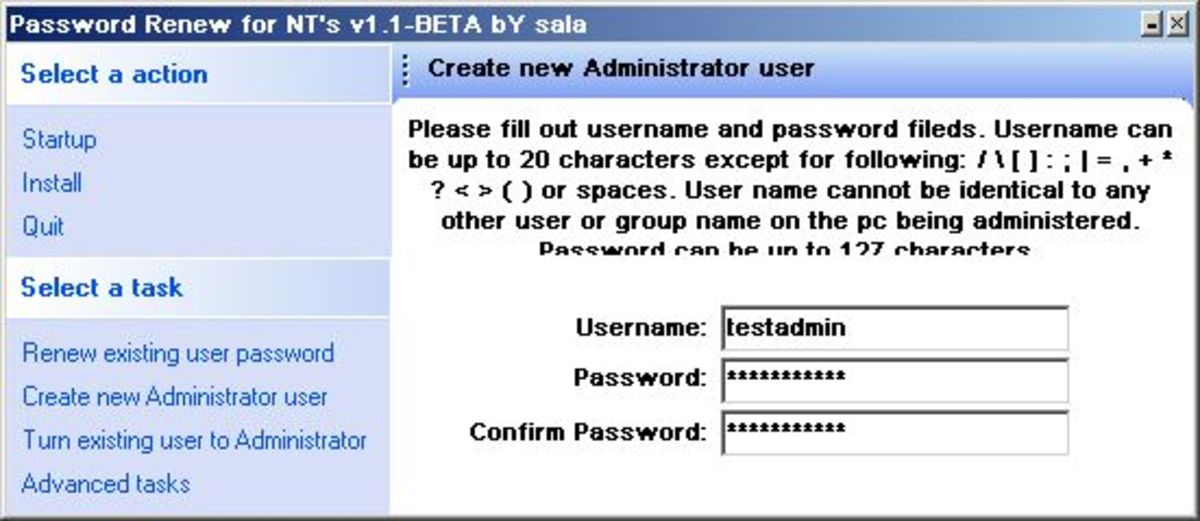
1) After booting the disc, select the mini XP option. Once your at the desktop click on the wrench icon in the notification area and navigate to Pass Renew. The path is: Passwords/Keys-Windows Login- Password Renew.

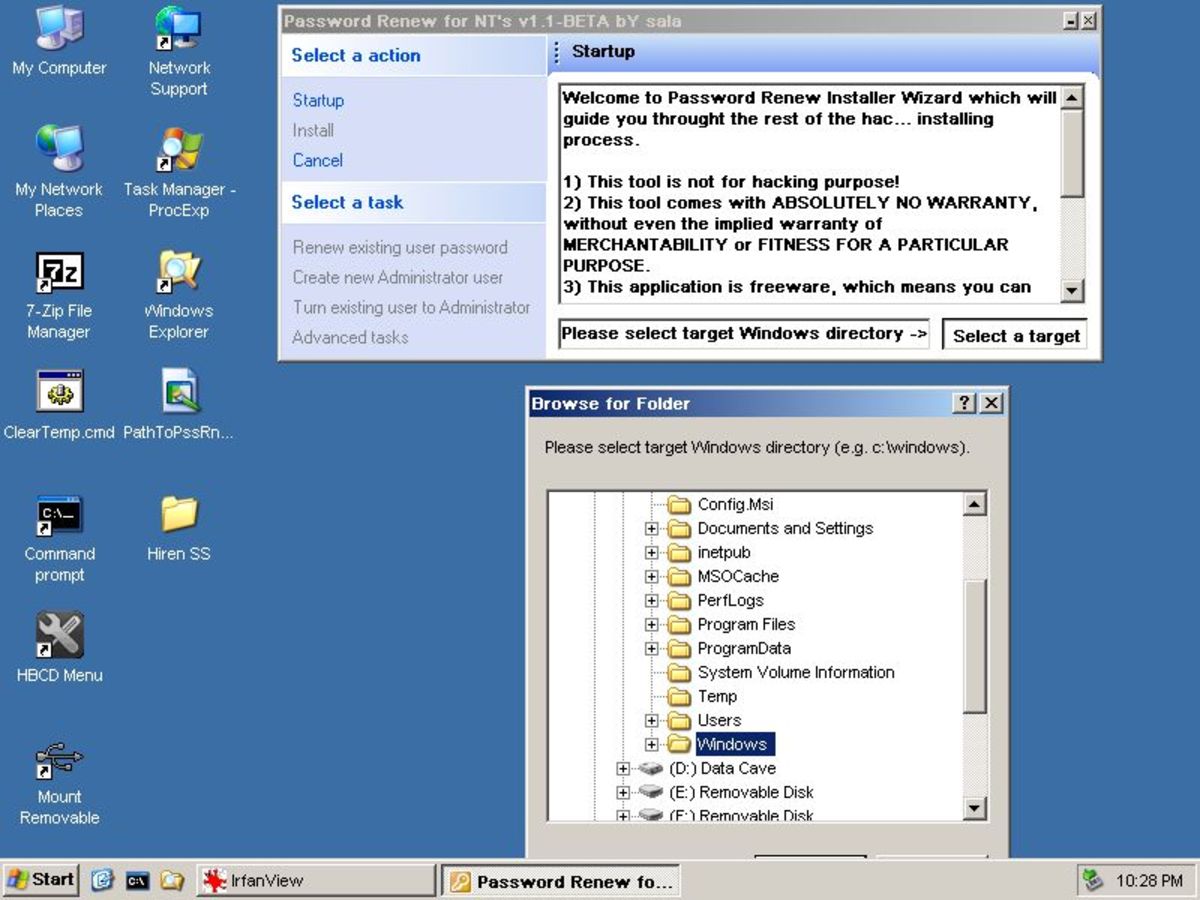
2) At the Pass Renew screen click on “Select Target” in the lower right. Then browse to the Windows folder on the local hard drive.
 
 
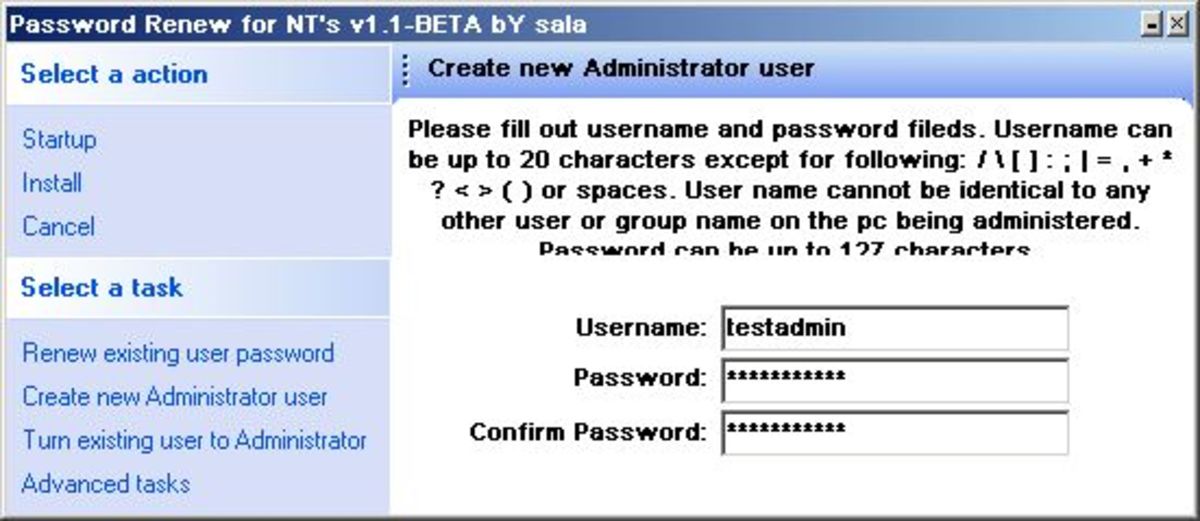
3) Click OK, then click on the “Create new Administrator user” option under “Select a task” on the left of the screen. Then enter the username and password you want to use for the new account. For this tutorial we’ll use testadmin as the username. Then click the “Install” option under “Select an (a) action” on the left.
 
 
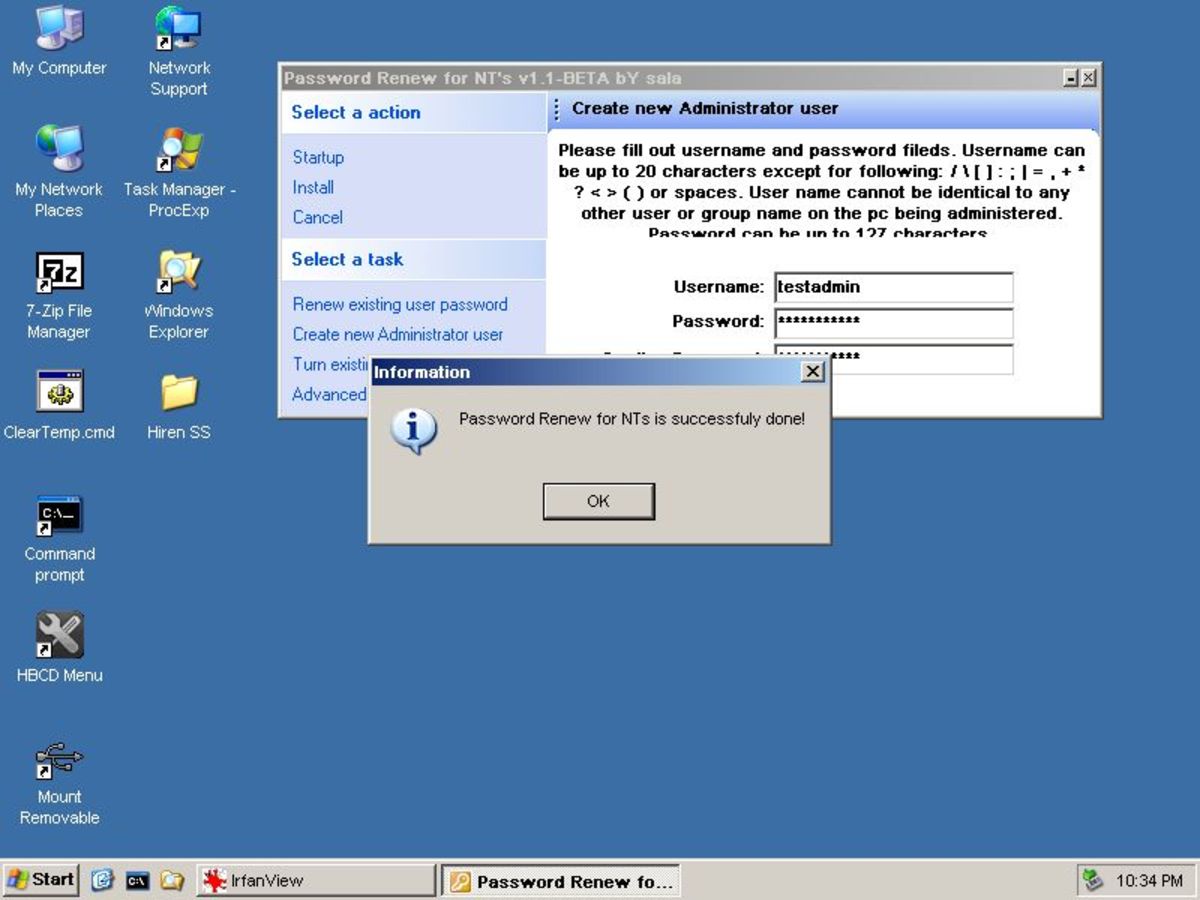
4) You will see a pop-up stating that the creating the new user is “Done.” Go ahead and click “OK”


5) Now there is one trick to this next step that you must do correctly. DO NOT “X” OUT! You must click the “Quit” option under “Select an action” to finish using the program and use the account just created. If you simply click the “X” then the account will show up on the Welcome screen but you won’t be able to logon. So make sure to click “Quit.”

Success!!!

That’s all there is to it. Now you can eject the disc and reboot the machine. If all has gone well you will see your new account and be able to logon.
Hiren’s Boot CD is among the best all purpose boot disc out there. With a large amount of antivirus apps and a huge variety of other tech tools there’s not much you can’t do with this disc. Honestly, I’ve tried most of them out there and other than the Backtrack CD there simply is no other disc I use.

Courtesy: Rome’s IT Guy - https://turbofuture.com/computers/Using-Hirens-Boot-CD-to-Create-Admin-Accounts

Friday, January 19, 2018

Multiple desktops in Windows 10

Multiple desktops in Windows 10
Multiple desktops are great for keeping unrelated, ongoing projects organized, or for quickly hiding from the boss that browser game you can't stop playing. To create multiple desktops: 
  • On the taskbar, select Task view > New desktop .
  • Open the apps you want to use on that desktop.
  • To switch between desktops, select Task view again.

Saturday, March 5, 2016

Acquiring mobile users is expensive, but here's why they're worth the cost

Even as cost-per-install rates soar, the cost of loyal users is going down. Here's what businesses building mobile apps should know.
Image: iStockphoto/Nongkran_ch
Apple's App Store may have created 1.9 million jobs, but it's unclear how many of those jobs pay a living wage. After all, VisionMobile's survey data has long revealed that most developers live below the app poverty line, making less than $500 per app per month.
There are signs, however, that life is getting better for mobile app developers.
SEE: Mobile device computing policy (Tech Pro Research)
App Annie, for example, is forecasting that the App Store will generate $101 billion by 2020. More importantly, however, the cost for acquiring a loyal app user, and not simply someone who installs an app, is in decline. With roughly 30% of all mobile advertising currently focused on getting people to download apps, everyone benefits if those billions of dollars start to create real brand loyalty, and not simply app churn.

Loyalty comes at a price

The cause for hope comes from recent Fiksu data. Fiksu, which specializes in helping brands build and run app acquisition and re-engagement campaigns, issues a monthly index that tracks the cost of generating app downloads and app loyalty, defined as a user that opens an app three times. Those numbers show though the cost per install (CPI) keeps going up, the cost per loyal user (CPLU) has declined a bit over the past year.
On iOS, CPI rose 12% to $1.64, a 28% increase over January 2015. On Android, CPI went the opposite direction, declining 44% to $1.91 from December 2015 while rising 25% since January 2016:

Now, compare this to the cost of acquiring a loyal user (CPLU), which plunged 34% since last month to $2.78, and experienced a year-over-year decline of 4%:

In short, the cost of corralling new users into your apps keeps going up, but the cost of generating loyal users seemingly paradoxically has been going down.
What gives?

Are we there yet?

The Verge's Casey Newton writes that "the App Store's middle class is small and shrinking. And the easy money is gone," which is correct, but doesn't tell the whole story.
For one thing, more and more companies aren't even trying to sell apps. Either they offer in-app purchases or, if they're a big brand like a hotel chain, they generate revenue through their app. For these companies, it doesn't matter whether the App Store economy is $101 billion or $1.01, because the revenue they generate is facilitated by apps but not counted as part of the "app economy."
Selling apps, in other words, is old school.

This is implied by the Fiksu data. When I asked Fiksu co-founder Micah Adler why CPLU has declined even as CPI has gone up, he made it clear that it has a lot to do with "higher quality" of installs.
And yet, big brands still need to find ways to get users to download and engage with their apps, and so should be concerned by CPI inflation. The good news is that mobile marketers appear to be getting better at generating app loyalty, and not merely app installs.
"This is because the average install this year has a higher likelihood of turning into a loyal user, compared to last year," Adler said. "So, even though it is more expensive to get a download, this is more than made up for by the higher quality."
By higher quality Adler really means better use of data, or "the ability to extract the right audiences from that data," as he told me. "By getting the right people to download the app, they are more likely to be long term users of the app."

Spending on engagement

Adler's response is understandably focused on optimization of ad spend, given that's what Fiksu does. But, lost in that analysis are the myriad other things that app developers are doing to foster loyalty in their user base.
While companies have increasingly focused on app engagement for years, it's only been in the last year that mobile marketing automation and related technologies have become more science than art. What used to be "dumb pipes" has become real-time, data-driven orchestration of notifications that nudge a user along a desired purchasing path.
Between optimized app user acquisition campaigns and ongoing improvements in engagement strategies, marketers are finally starting to get real value for their mobile marketing spend. That's good news for the app economy, but it's great news for every business that depends on mobile...which is every business.

Intuit sells Quicken to private equity firm in management buyout

33-year-old personal finance software will be bolstered by more Mac development, improvements in reliability on Windows, says current Quicken manager

Credit: Intuit
Intuit yesterday said it had sold its Quicken personal finance software unit to H.I.G. Capital, a Miami-based private equity firm.
Financial terms of the deal were not disclosed.
The announcement put an end to a sales process that went public last August, when Intuit told customers it was unloading three parts of its business -- Quicken, QuickBase and Demandforce -- to focus on its most profitable software and services, the QuickBooks small business accounting division and the seasonally-skewed TurboTax tax preparation group. In January, Intuit sold Demandforce to Internet Brands for an undisclosed amount.
Last summer, Intuit's CEO explained that Quicken, which unlike QuickBooksand TurboTax lacked a cloud-based service or subscription offer, was essentially a dead end for the company. "Quicken is a desktop-centric business and it doesn't strengthen the small business or tax ecosystems," said chief executive Brad Smith in a conference call with Wall Street last year. "Our strategy is focused on building ecosystems and platforms in the cloud."


Quicken's contributions to Intuit's bottom line have been minuscule: In the 12 months preceding the August announcement, Quicken, which starts at $35.10 (Amazon price), contributed just $51 million to the firm's total revenue of nearly $4.2 billion, or slightly more than 1%.

But the company pledged to find a buyer who would invest in the 33-year-old Quicken software. That buyer turned out to be H.I.G. Capital, a global private equity firm that manages some $19 billion.
Eric Dunn, the head of Quicken, announced the sale in amessage and video posted to Intuit's website.
"[H.I.G. is] confident, as am I, that Quicken will thrive with increased investment, leading to product improvements and advances that will allow Quicken to continue to serve you well for decades to come," Dunn said.


The sale, said Dunn, will allow Quicken to double the number of engineers working on the Mac version -- which has long lagged behind the Windowsedition in features and functionality -- and devote more resources to improving the program on the dominant platform, Windows.
"We all know that Quicken could use some TLC, some tender loving care, to be as great as it can be. I'm very aware that Quicken isn't perfect," said Dunn. "Quicken [for Windows] could probably use some attention to the fit and finish, the polish, usability, resilience and reliability."
Dunn has his work cut out for him.
In many ways, Quicken is software that users love to hate. With years of data in the company's proprietary format -- and few alternatives -- they not only feel trapped but also regularly rail about the product. Quicken's listing on ConsumerAffairs.com, the consumer advocacy organization's website, makes for dismal reading: The overall satisfaction rating is one star out of a possible five.

"Like many other Quicken users, I ran into problems with Quicken 2016," complained someone identified only as "John" last month on ConsumerAffairs.com. "Quicken has the worst customer service of any major company with which I have had to deal. Their representatives are uninformed and untrained in the most simple issues."
The sale was a management buyout: Dunn confirmed that he was a "significant personal investor in the transaction." How that will work out over the long term was, not surprisingly, unclear.
Typically, a private equity firm that has partly financed a management buyout -- in such deals, managers are required to make personal investments to guarantee that they have a vested interest in success -- wants out after several years to recoup their investment and, assuming the transition has worked, to take a profit. At that point, the firm may be in the hands of management; or the equity firm's stake could be sold to another buyer or investor.
H.I.G Capital has invested in other software or software-based services recently. In January, H.I.G. was among the investors that bankrolled the purchase of Salary.com, a Wellesley, Mass. firm that focuses on employee compensation data, software and services. That was a management buyout as well: Salary.com's founders bought the company from IBM, which had acquired it in 2012 as part of a larger purchase of Kenexa.
The Quicken sale is expected to close by April 30.

Ubuntu convergence finally impresses me

Image: Jack Wallen
It's taken me a long time to get on board the Ubuntu convergence train. I've been very pessimistic about the whole platform, based on the terrible state of Ubuntu Phone (as run on the Bq Aquaris handset).
But then, I happened to watch a video, by the wonderful people of XDADEVELOPERS, from Mobile World Congress, in which John Lee (of Canonical) demonstrates convergence with Ubuntu Phone running on an older Nexus 4 handset.

This video came just a week or so after Canonical made the first official announcement of a Ubuntu tablet to be released. This table will be manufactured by Bq and will be a part of the same Aquaris line as is their Ubuntu phone. The specs for the tablet aren't too shabby:
  • Display: 10.1-inch IPS touch display (1920×1200 pixel resolution at 240 ppi)
  • CPU: 64-bit MediaTek MT8163A 1.5GHz quad-core processor
  • RAM: 2GB of RAM
  • STORAGE: 16GB (micro SD memory card is included, adding storage expansion of up to 64GB)
All of this is fine and good...but up until now everything I have seen from Bq has been less than impressive

Let me explain.
However, after digging around a bit (and watching the above video from WMC), I realize that all the criticism tossed at Ubuntu Phone has been premature.
First and foremost, we get what convergence is. You use a single device for all your needs:
  • You carry your phone with you all day
  • You work on your phone
  • You plug your phone into a monitor and switch it to desktop mode
  • You work at your desk with your phone
  • You unplug your phone, switch it to phone mode
  • You go home
  • You plug your phone into your monitor at home and switch it to desktop mode
  • You play on your phone at home
  • Wash, rinse, repeat
For some of us, this doesn't make sense. Why? Because we're of an older mindset that precludes us from making a smartphone or tablet our only device. I do things that require some serious power (rendering videos and audio). But the truth of the matter is, a large percentage of people (especially of the millennial generation) have forsaken the tried and true form factor for their mobile devices. So when you consider this, convergence makes perfect sense. And, after watching the Canonical demo, the light goes off over my head and I can finally shout, "Ah ha!"

But what about...

The first question that comes to mind, when you consider this relative newcomer to the mobile space, is that of apps. As it stands, there are very few apps available for the Ubuntu Phone platform. To settle that issue, there is one thing you must consider:
Ubuntu Phone is still very much in development.
In fact, I would go so far as to say Canonical was quite premature in the releasing of devices. You see, this whole schmear isn't going to spread properly until Unity 8/Mir is released. At that point, everything changes. Once the Ubuntu desktop is in conjunction with the phone/tablet space, everything will be running the same platform, the same code. That is when things get interesting. When we finally see phone/tablet/desktop running the same release of Ubuntu, we'll see convergence finally work as it should. Why? Because all those apps we depend upon (LibreOffice, Audacity, Gimp, etc) will run on the convergent platform.
It should be noted, however, that the Bq Aquaris M10 will ship with LibreOffice, Mozilla Firefox, The GIMP and Gedit pre-installed. That's right, full-blown legacy apps running on the mobile platform. The current release date of the M10 is set for March, 2016.

Premature release of the platform

Lots of work still must be undertaken before this will come to fruition. That is why I believe Canonical was premature in releasing any devices. So far everyone has been less than kind to the Ubuntu Phone platform. What we really didn't understand (even though it was staring us in the eyes) was that we were seeing software very much in beta...maybe even alpha. It's a very rare occasion that a piece of beta software is ready for release. That was the disconnect. Ubuntu Phone has not (and is still not) ready for release.
The good news is that Unity 8/Mir are just around the corner. Canonical has given us every indication that Ubuntu 16.10 will ship with the new platform. I will, however, offer up this piece of advice. When Ubuntu 16.10 does ship (October, 2016), make sure Ubuntu Phone is ready to deliver on the promise of convergence...completely. If Canonical can pull off the full blown convergent experience (as in all legacy apps run on the platform), then they will have a major victory on their hands (as well as a platform ready for public consumption).
I hope this happens. Canonical and the Ubuntu Phone developers have been working tirelessly on this project and it needs (nay, deserves) a win of this magnitude.
Do you think Canonical's take on convergence will succeed? If not, why?

Trump says ‘I’m changing’ H-1B position -- then says he isn’t

During Detroit GOP debate, Trump says one thing and then clarifies it after

Credit: Gage Skidmore/Flickr
Early in his quest for the Republican nomination for president, Donald Trump promised major H-1B reforms. But Thursday night, at a debate in Detroit with his fellow Republican candidates, Trump said he was "softening" his position.
The move created an instant mess for Trump. So early this morning, his campaign issued a statement condemning the H-1B program and stressed the need to "hire Americans first."
But the damage was done.
Norm Matloff, a computer science professor at the University of California at Davis and a leading critic of the visa program, noted in a post-debate blog post: "I'm getting e-mail messages from some absolutely furious supporters of Donald Trump — who are now FORMER supporters of Trump."


The trouble began with a question from Fox News Reporter Megyn Kelly about inconsistencies in Trump's statements. Said Kelly: "Mr. Trump, your campaign website to this day argues that more visas for highly skilled workers would, quote, "decimate American workers." However, at the CNBC debate, you spoke enthusiastically in favor of these visas. So, which is it?" (see transcript)

"I'm changing. I'm changing," said Trump, in response. "We need highly skilled people in this country. In Silicon Valley, we absolutely have to have."
He also said: "I'm changing it, and I'm softening the position because we have to have talented people in this country."
Trump's post-debate statement suggested that Kelly's question wasn't specific to the H-1B program: "Megyn Kelly asked about highly-skilled immigration." Then the statement goes to attack the visa program:


"The H-1B program is neither high-skilled nor immigration: these are temporary foreign workers, imported from abroad, for the explicit purpose of substituting for American workers at lower pay. I remain totally committed to eliminating rampant, widespread H-1B abuse and ending outrageous practices such as those that occurred at Disney in Florida when Americans were forced to train their foreign replacements. I will end forever the use of the H-1B as a cheap labor program, and institute an absolute requirement to hire American workers first for every visa and immigration program.
"No exceptions," wrote Trump.
Trump's statement appears to argue that he was discussing green cards, permanent immigration, for university graduates and not H-1B visas.
But Kelly was asking Trump about the H-1B program. She used the word "decimate," in her question, citing the same word Trump's platform uses in its criticism of the higher H-1B visa caps sought in the I-Square bill, co-sponsored by Sen. Marco Rubio (R-Fla.), one of Trump's GOP presidential rivals.

Trump, in response to Kelly's question, spoke about how foreign students will go to Harvard, Stanford and Wharton and "as soon as they're finished they'll get shoved out. They want to stay in this country. They want to stay here desperately, they're not able to stay here.
"For that purpose, we absolutely have to be able to keep the brain power in this country," said Trump.
Pressing for clarity, Kelly asked Trump: "You are abandoning the position on your Website?"
Trump's H-1B position has two main features. It raises the pay of visa workers to keep employers from paying entry-level wages. Higher salaries "will force companies to give these coveted entry-level jobs to the existing domestic pool of unemployed" workers "instead of flying in cheaper workers from overseas."
A second major feature is the campaign's "hire American workers first" edict. Trump wrote that H-1B "petitions for workers should be mailed to the unemployment office, not USCIS (U.S. Citizenship and Immigration Service)."
During the debate, Kelly also quizzed Sen. Ted Cruz (R-Texas) about his inconsistencies on the H-1B program. She pointed out that Cruz supported a major hike in the visa cap, and did not join the group of bipartisan Senators seeking an investigation of the program following Southern California Edison's layoff last year.
"The abuse of the H-1B program has been rampant," said Cruz, in response.
Cruz is co-sponsoring legislation with Sen. Jeff Sessions (R-Ala.) tosubstantially hike H-1B wages, tighten program rules and eliminate non-disparagement clauses that serve to keep IT workers from speaking out.
As president, Cruz said he would impose a 180-day moratorium on the H-1B program and "implement a comprehensive investigation, because "you got U.S. companies that are firing American workers, bringing in foreign workers, and forcing them to train their replacements."
Trump recently received the endorsement Sessions, who also heads the Senate immigration subcommittee. Two former IT workers, who each said they had to train a foreign replacement, spoke at a recent Trump rally.

Friday, March 4, 2016

Are Your Kids The Latest Target Of Hackers?

The short answer is yes. V-Tech and Hello Kitty join the depressingly long list of companies to have been hacked in 2015. This time, however, the data taken were overwhelmingly about children – their usernames, passwords, addresses, birthdays, photos, and other personal information.
At first glance, you may be wondering why hackers would bother, but there are three major reasons for targeting toy companies. First, they are an easy target. V-tech representatives admit that the company’s security was subpar. Second, children tend to reuse passwords just like adults do, so getting a password for one site may unlock most, if not all the sites that child uses, and of course, some sites require payment for various features to be unlocked, or are purchasing portals, so the child’s information may inadvertently expose a parent’s credit or debit card information.
Third, and perhaps most chillingly, it could well be about the long game. A hacker need only wait until the child is old enough to get a credit card and then steal his or her identity. It’s not like it costs anything to store the data and wait, and given how easy it was to breach V-Tech and Hello Kitty’s security, that’s as good as being handed free money.
There are two tragedies rolled into one here. The first and most obvious is that not even our kids are safe from hackers, and nothing seems sacred to them. The second is that the breach could have been avoided. It’s not like V-Tech or Hello Kitty didn’t have ample warning or ample opportunity to protect themselves against such things. Online tech portals have been screaming from the rooftops all year about the dangers, and outlining the steps companies need to take if they want to be secure. V-Tech and Hello Kitty simply opted to do nothing with the information. That makes it somewhat difficult to feel sorry for them. They got lucky for a while, skating by with minimal security. Looks like their luck ran out. How’s security at your company? If you are unsure, a network audit is probably your best first course of action.

5 tips for turning a business unit into a startup

Turning a business unit like IT from internal to external-facing is tricky. Here are five keys to make it a successful change.

Large and mid-sized companies are particularly well-suited for enhancing existing products or for coming up with new ones that are directly within their lines of business. However, a trickier proposition is commercializing a business unit like IT, which traditionally is viewed as an internal cost center that serves the needs of other company departments.
First, there is a natural bias against turning IT (or any other administrative function) into a business unit that has external as well as internal customers. This is because there is fear and trepidation that IT cannot serve more than one master—and that, inevitably, service levels within the company will fall if IT also has to worry about pleasing outside customers.
There is also the problem of who is going to head up an entity that has always been an internally focused department, and that now is being tapped to serve outside customers. CIOs and IT'ers in general tend to be technical and introspective. They do not always make good salespersons and promoters.
Nevertheless, there are companies that have successfully spun off profitable businesses from internally focused departments like IT, and from these efforts we have learned what works. Here are five best practices that characterize these successful startups:

1. Perform the upfront due diligence to validate that there is a viable business

There has to be an extremely compelling business case to transform an internal business unit into an external business. On the financial side, there must be sufficient commercial opportunity to at least produce breakeven results in a very short time. Most likely, this means that outside customer commitments are already lined up. The new spinoff organization will likely be drawn from internal personnel, and the impacts of such a move need to be weighed so that they don't present any risk to corporate service levels.

2. Decide who is going to staff this business unit

The individual heading the startup must have a combination of business savvy and technical knowledge in the set of services being sold. He or she should have the skills bandwidth to work with both innovators and administrators. This is a difficult hybrid set of leadership skills to find, but it's almost always required, or the startup will be in jeopardy. Second, the internal staff that is identified to work in the startup should be fully assigned there—and not function with a split of responsibilities between the startup and the enterprise. This can best be affected (and afforded) when the organization has solid bench strength behind these key individuals. Finally, the startup must have a very service-oriented staff with business acumen and an ability to empathize with their customers' needs. If the startup can't provide excellent service, it will have difficulty getting (and retaining) customers.

3. Determine the legal framework that the new company will operate under

Will the startup be a subsidiary, a new line of business unit within the enterprise, or a totally independent company with an independent board? How will the enterprise be represented on the board, and who will fill any board positions that are not occupied by the enterprise? There are pros and cons to each approach, and it is important for startup promoters, legal counsel, the CFO, the CEO and others to review all of these scenarios and to determine "best fit."

4. Sell the idea to the CEO, the CFO, other C-level management and the board

Startups are fraught with risk, even with customer commitments and the ability to leverage enterprise resources and personnel that already exist. Whether it is the CIO, a line of business managers, or any other manager in the enterprise, business viability due diligence, customer commitments, projected staffing and operational expenses of the organization, the services the startup will offer and how they will be priced, the potential opportunity risks, etc., should all be thoroughly discussed with C-level managers, the board, attorneys and any other stakeholders in the process. These discussions should begin as informal what if meetings that graduate into more serious discussions—until they reach the level of a board meeting, when the proposal comes up for approval. A consensus-building process like this can take months, but it is well worth it because those promoting the startup must get everyone on board.

5. Focus the startup on service and innovation

Customers coming to the startup, especially if it is an IT endeavor, are looking for technology solutions, excellent service and a fair price. The startup must be equipped with a compelling solution that immediately meets pressing customer needs. The startup must possess the skills and talents to continuously innovate and build on this solution. Pricing must also be competitive. More than anything, however, startups can move toward the head of the class if they can provide consistently excellent service. Good service is the Achilles heel of many vendors in the IT marketplace, but an area of concern that customers never overlook.

How the next president will change the H-1B visa

Here's an early outlook on how the various presidential candidates may approach this issue if elected.

What if Trump wins the presidency?

President Donald Trump would change things.


India is on Trump's list of countries "ripping off" the U.S., along with China, Japan and Mexico. His immigration platform includes a series of H-1B reforms, including a hire-Americans-first provision.
Laid off Disney IT workers, who complained of training visa-holding replacements, spoke this week at a Trump rally. Sen. Jeff Sessions (R-Ala.), a leading proponent of H-1B reforms, is endorsing him.
If the Republicans continue to hold both chambers of Congress, the prospects for a standalone H-1B bill improve.
Comprehensive immigration reform proponents oppose piecemeal approaches, blocking H-1B cap increases as well as reforms. President Barack Obama may veto a standalone reform bill, but President Trump would likely sign the bill.


But Trump, the billionaire businessman seeking the GOP nomination, is also a wild card.
Trump may want H-1B reforms bundled with the legislation he needs to build a border wall and fund mass deportations, setting the stage for a different kind of fight with Congress.
From a tech industry perspective, the most immediate danger posed by a President Trump may his use of the president's executive powers. He could attack the H-1B program with new enforcement approaches, as well curb the Optional Practical Training STEM extension that Obama now wants to expand.

What if Clinton wins the presidency?

Former Secretary of State Hillary Clinton doesn't talk about the H-1B program. She doesn't mention it in her immigration platform or on the campaign trail. But she is not a total enigma.
Clinton, who is seeking the Democratic nomination, supports comprehensive immigration reform. She is unlikely to rile India on trade, but would accept some reforms to the H-1B program if they are part of a comprehensive immigration bill.

It remains to be seen whether Clinton -- possibly to offset Trump on this issue -- will be forced to directly talk in the campaign about the H-1B issue.

What if Bernie Sanders wins the presidency?

U.S. Sen. Bernie Sanders, the Vermont independent seeking the Democratic nomination, is a critic of the H-1B program and would be receptive to standalone reform legislation.
Sanders and Clinton haven't talked about the visa program in any of their debates. It's been a missed opportunity, and the people at fault are the national news reporters who pose the questions.

What if Rubio wins the presidency?

U.S. Sen. Marco Rubio (R-Fla.) is aligned with Sen. Orrin Hatch (R-Utah), who is the tech industry's chief Senate advocate for increasing the H-1B visa cap.
But Florida is ground zero for some of the most visible H-1B-related layoffs, with the Disney just the latest. Rubio's pro-industry views may be tested here.
U.S. Sen. Bill Nelson (D-Fla.), has been troubled by the Disney layoffs, but Rubio apparently has not been.
If Rubio can win in Florida, it may be proof that the H-1B issue is too niche and a non-factor in a national contest. The next two weeks may determine whether this issue has legs in the national debate.

What if Cruz wins the presidency?


Sen. Ted Cruz is co-sponsoring H-1B reform legislationwith Sen. Sessions. His bill attacks H-1B usage by raising the wages of visa workers. It also includes a prohibition on non-disparagement clauses that keep IT workers from talking publicly about their experiences.
If Cruz raises the H-1B issue at all in his campaign, it ought to be in Florida.
Rubio has tried to offset Cruz's H-1B reform legislation by ignoring the Sessions/Cruz bill and pointing out, instead, that in 2013, Cruz supported a substantial hike in the H-1B visa cap. Rubio is a sponsor of Hatch's Immigration Innovation Act, also called the I-Squared Act, which would raise the annual base H-1B cap to between 115,000 and 195,000 visas. (The current annual base H-1B cap is 65,000.)
As president, Cruz would work with Sessions and other H-1B reformers. He might attack the OPT program as well, using his executive powers.

What impact is the presidential contest having on the H-1B issue?

One clear impact is being felt by Nasscom, India's IT trade group. It is stepping up defense of the offshore industry model.
R. Chandrashekhar, the industry group's president, argues that the use of IT services firms is about improving and modernizing IT operations at clients' businesses. The visa workers aren't there to simply replace the U.S. workers, but to modernize IT operations, he argues.
"It's certainly not with the intention of just getting in a set of people to replace an existing set of people and continue to do things in the same manner," said Chandrashekhar, in an interview. "That doesn't make for a good business casein any sense."
What Chandrashekhar doesn't want is for India to be singled out by lawmakers.
Many of the reform proposals attack the wages paid to H-1B workers. If visa wages rise, the economics of offshoring decisions change, argue reform proponents.
Whatever is done by lawmakers regarding the H-1B visa, "it should be applied uniformly to everybody," said Chandrashekhar. That means any reforms apply to U.S. outsourcers as well as to overseas firms.

Can the presidential election actually change the way the H-1B program operates?

Whether a new president can change the IT offshoring industry by altering the H-1B visa program remains to be seen.
The president has executive power and can complicate the H-1B program, but Congress sets the visa cap and many of the visa rules. The lobbying forces are powerful. The IT workers at risk are mostly invisible.
IT workers who have been "shadowed," participated in "knowledge transfer" or otherwise trained their replacements are often older, and have long tenures. They may make good money and benefits.
These are the workers who run the IT systems that power manufacturing systems, utilities, healthcare and retailers, and are far removed from the glamour jobs at Twitter, Google, Facebook and the catchy startups.
One former utility IT worker posted an ad on Craigslist, since removed, with the title: "50% off labor sale -- outsourced IT worker."

Reference & Courtesy: http://www.computerworld.com/article/3040384/it-careers/where-the-presidential-contenders-stand-on-h-1b-visa-issues.html

Thursday, March 3, 2016

IT Growth Outlook is Bright

With spending on hardware and software reaching record amounts, new research shows the IT industry's growth outlook has reached its highest level in five years.
Fueling the growth, according to the CDW IT Monitor, is the anticipated record-high demand for hardware and software investments. The data shows 80 percent of IT decision-makers are planning hardware spending, up 4 percentage points from October. Small businesses and local and state governments are expected to see the most significant increases.
Additionally, 82 percent of IT decision makers are anticipating making software purchases, up 7 percentage points.
Neal Campbell, senior vice president and chief marketing officer for CDW, said the data indicates that the IT spending outlook, first established in 2007, has reached a significant milestone.

"More IT decision-makers are feeling optimistic about the prospects of their IT budgets increasing, and they are anticipating significant IT investments in the next six months, especially on the hardware and software fronts," Campbell said. "We believe that organizations will continue to look at technology investments as ways to boost efficiencies, increase productivity and gain new competitive advantages in 2012."
Optimism regarding increased IT spending is the strongest among IT decision-makers in the health care, manufacturing and IT industries, according to the research.
The retail industry also continues to increase its investment optimism. IT leaders anticipate hardware and software purchases to increase by 3 and 9 percentage points, respectively, from October.
The CDW IT Monitor is based on surveys of more than 1,000 IT decision-makers representing all sizes of companies and multiple industries, across three levels of government.